


What is 4WD 240HP Tractor for Farm & Construction
Construction tractors are powerful heavy-duty machines designed to easily perform various tasks on construction sites. They play a crucial role in various construction related processes like site preparation, excavation and levelling of terrain.their immense power and traction enable them to operate efficiently in challenging terrains like uneven or muddy surfaces.
Benefits of 4WD 240HP Tractor for Farm & Construction
Increased Efficiency: Modern tractors streamline farm operations, lowering guide labour and completing responsibilities in much less time.
Precision Agriculture: Tractors geared up with GPS and superior sensors permit precise planting, fertilizing, and spraying, improving crop yields.
Versatility: From ploughing and seeding to harvesting and hauling, cutting-edge tractors can easily handle a wide variety of farm activities.
Comfort and Ergonomics: Amazing ergonomics enhance comfort during long working hours, lowering fatigue and improving productivity.
Environmental Benefits: Tractors with green engines and emission control structures minimise environmental effects at some point in farm activities.
Safety Features: Integrated safety technologies, including rollover safety structures (ROPS), ensure operator protection and reduce the chance of accidents.
Connectivity: Connectivity features allow tractors to be monitored remotely, permitting farmers to track overall performance, schedule upkeep, and troubleshoot problems.
Data-pushed Decision Making: Tractors equipped with onboard computer systems gather and examine information on soil situations, crop fitness, and gadget performance, facilitating knowledgeable decision-making.
Customisation Options: Modular designs and optionally available attachments permit farmers to customise tractors for unique responsibilities and terrain conditions.
Longevity and Reliability: Robust construction and advanced engineering ensure that cutting-edge tractors withstand rigorous use and offer dependable service for many years.

High-Performance 200HP 6-Cylinder 4WD Agricultural Tractor
● The engine has strong power, low fuel consumption and reliable quality
● The newly developed enhanced chassis, gearbox, gearbox housing, and rear axle housing are reinforced to improve reliability.
● Gear is 24 forward gear and 24 backward gear, the standard low-speed crawling gear, the minimum speed is 4.3 meters/min, can meet the straw baling, yam ditching and other different operations.

200HP 6-Cylinder 4WD Farm Tractor for Heavy-Duty Farming
● The engine has strong power, low fuel consumption and reliable quality
● The newly developed enhanced chassis, gearbox, gearbox housing, and rear axle housing are reinforced to improve reliability.
● Gear is 24 forward gear and 24 backward gear, the standard low-speed crawling gear, the minimum speed is 4.3 meters/min, can meet the straw baling, yam ditching and other different operations.

Powerful 200HP 6-Cylinder 4WD Tractor for Large-Scale Farms
● The engine has strong power, low fuel consumption and reliable quality
● The newly developed enhanced chassis, gearbox, gearbox housing, and rear axle housing are reinforced to improve reliability.
● Gear is 24 forward gear and 24 backward gear, the standard low-speed crawling gear, the minimum speed is 4.3 meters/min, can meet the straw baling, yam ditching and other different operations.

Durable 200HP 6-Cylinder 4WD Tractor for Versatile Farm Use
● The engine has strong power, low fuel consumption and reliable quality
● The newly developed enhanced chassis, gearbox, gearbox housing, and rear axle housing are reinforced to improve reliability.
● Gear is 24 forward gear and 24 backward gear, the standard low-speed crawling gear, the minimum speed is 4.3 meters/min, can meet the straw baling, yam ditching and other different operations.

Letol Brand 100HP 4WD Farm Tractor From Factory
The Letol 1004 wheeled tractor is an advanced four-wheel drive wheeled tractor developed by Leitai Agricultural Equipment according to market demand. Using Kunming Yunnei/Xinchai/YTO engine, self-developed reinforced TB chassis, 12F+12R multiple gears, adopting dual action clutch, third-generation luxury air-conditioned cab, equipped with reverse image, pneumatic shock absorber seats, self-developed streamlined hood with European style counterweights, standard with three-way hydraulic outputs, three-point reinforced quick connect suspension, matched with strong lifting and strong lowering system, to meet the needs of different users.
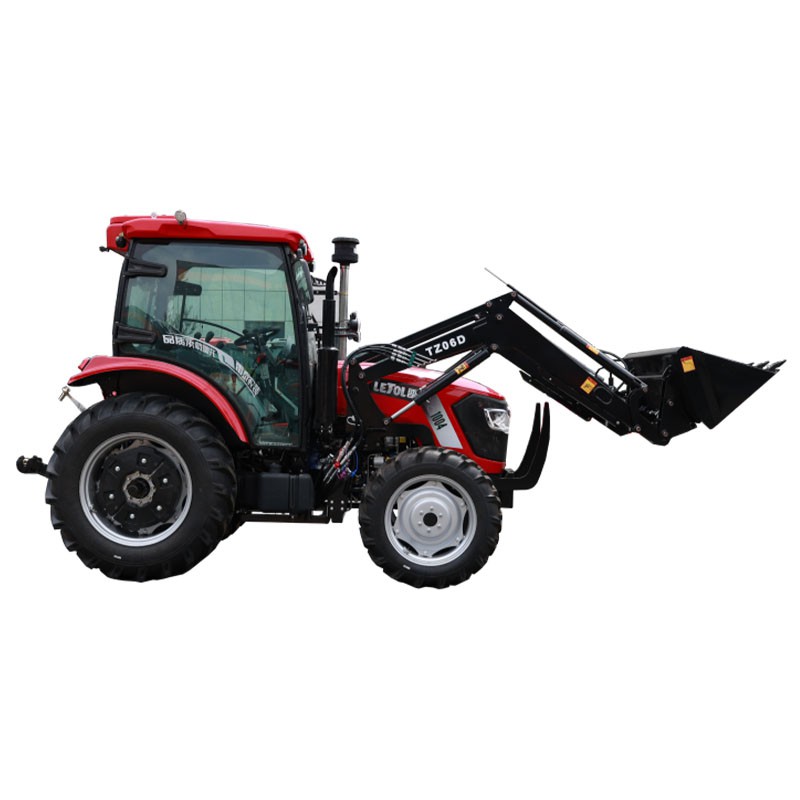
Factory-Direct Letol 100HP 4WD Agricultural Tractor
The Letol 1004 wheeled tractor is an advanced four-wheel drive wheeled tractor developed by Leitai Agricultural Equipment according to market demand. Using Kunming Yunnei/Xinchai/YTO engine, self-developed reinforced TB chassis, 12F+12R multiple gears, adopting dual action clutch, third-generation luxury air-conditioned cab, equipped with reverse image, pneumatic shock absorber seats, self-developed streamlined hood with European style counterweights, standard with three-way hydraulic outputs, three-point reinforced quick connect suspension, matched with strong lifting and strong lowering system, to meet the needs of different users.

50HP 4WD Farming and Garden Tractor
●Strong 8F+8R, TE chassis
● The engine has strong power and Low fuel consumption

Versatile 50HP 4WD Tractor for Farming and Gardening
● Large torque reserve and good power economy
● Compact structure, The front axle with a large steering angle ,small turning radius, short wheelbase, widened tires for better grip

Powerful 50HP 4WD Garden and Farm Tractor
● Flexible; hydraulic steering gear, Easy to operate
●Adopting wet, disc, self-boosting brakes, stable and reliable braking
Why Choose Us
Commitment to quality
We're committed to quality and concrete actions. That means we always deliver solutions in a professional and practical way.
World-wide expertise
We know international markets and trends. Our expertise, experience and network cover all corners of the world.
Competitive Price
We have professional sourcing team and cost accounting team, stive to reduce cost and profit and provide you a good price.
One-stop Solution
With rich experience and one-to-one service,we can help you choose products and answer technical questions.
Guidelines for Choosing the Best Tractor for Your Farm
Take consideration of your property
Consider your farm's size before selecting a tractor, and vice versa. spraying, mowing, etc., whereas smaller farms may be able to get by with tractors with roughly 47 HP.
Your Budget
Tractors can be expensive, making them a substantial investment. This is crucial to note. To help you find the tractor you want, you must have a set spending limit. which can handle various tasks at a reasonable cost, would be something you should think about purchasing.
Horsepower
The choice of horsepower in a tractor is a crucial decision that is dependent on the size of your farm as well as the variety of tasks to be done. At present, there are two types of ratings used by the manufacturers to measure the power of the tractor:
– Engine horsepower
– PTO horsepower
The Engine
It is important to note that your tractor is only as powerful as the engine within it. The engine determines the horsepower of the tractor and the kind of work that it can handle. This is why the engine is an important factor when deciding to buy a tractor.
Comfort and Safety
Look for the comfort and safety of the tractor while buying. You can concentrate on a few standard elements, such as:
Adequate space between the pedals and fenders
Appropriate operator platform design
Seat adjustment and steering wheel
The ability to reach controls comfortably
Good handhold condition
Visibility of panel lights
Main Components Of The Agriculture Tractors
(1) I. C. engine
The first and the foremost part of the tractor is the Internal Combustion Engine. In the engine, the combustion of an oxidizer and fuel is produced in a confined space that is referred to as a combustion chamber. An engine is placed over the tractor. In a tractor, the engine power starts from 20 to 120 horsepower.
(2) Clutch
To connect and disconnect the tractor engine from the drive wheels and transmission gears, the Clutch plays a vital role in the functioning of the tractor. The power is transmitted through the clutch system by means of friction between driven members and driving members.
(3) Transmission gears
To control the speed of the tractor in different variants in the rear wheel of the tractor. Tractor transmissions have the power to control different gears or powers. To control the speed of the tractors in different conditions between the shifting of gears and directions so that it becomes free and smooth. Basically, the gears used on tractors are of two types:
a.Constant Mesh Type Transmission B. Selective Sliding Type
Selective Sliding-type transmission gears consist of main features such as Gear Shifting Gears, Gear Housing, Main Shaft, Output Shaft, And Counter Shaft or Layshaft.
(4) Differential unit
The differential unit works effectively while permitting one of the rear wheels to rotate faster and slower. The differential unit comprises of
1. Crown wheel
2. Half shaft and
3. Differential casing
4. Differential pinion
5. Bevel gear
(5) Rear wheels
The large rear wheels of the tractor are fixed on the backside of the driver's seat ensuring the ability to work in the field.
(6) Front wheels
As the name implies the front drive wheels or tires, are two-wheel drive tractors, are smaller as compared to rear tires. When the tractor is working in the field, front-wheel drive is used at all times.
(7) Steering mechanism
In tractors, when the operator turns the steering system governs the angular movement of front wheels. The system of steering mechanisms is composed of different components like Steering Shaft, Steering Wheel, Steering gears, Drag Link, Kingpin, etc.
(8) Hydraulic control and hitch system
Tractors are equipped with a hydraulics system for operating a three-point linkage system. Hydraulic systems work effectively to raise, control, hold, the mounted or semi-mounted implements for better farm operations.
(9) Brakes
The primary function of the brakes in the tractors is to stop or slow down the motion of a tractor. It operates by the two independent pedals and is mounted on the driving axle. There are two different kinds of brakes that function differently. They are Mechanical Brakes and Hydraulics Brakes.
Uses of tractors in agriculture
Compact tractors
Vineyard and orchard farming operations are best carried out with compact tractors or tiny tractors. They often have wide rear track widths and comfy, adjustable chairs. Uses of mini tractors in agriculture are to trim trees, pick low-hanging fruit, and more.
Implement carrier tractor
The implement carrier tractor is the one that is used for mounting and hauling various implements. Sprayers, drills, loaders, rotary sweepers, seed drills, and other tools are among the implements. There is also an extra between the chassis of their front and rear tires due to the weight of the additional equipment they are carrying.
Garden tractors
The uses of garden tractors in agriculture are to create flower beds and cut the lawn, and garden tractors. Garden tractors have a compact design and an engine with a power range of 1 HP to 20 HP. Their convenience makes them ideal for gardeners.
Utility tractors
Uses of these tractors in agriculture are for tasks like ploughing and towing large tools.adopting utility tractors helps reduce the extra expenditures associated with buying different machinery to complete duties.
How to reduce the risk of tractor accidents
Be Physically and Mentally Fit
There are numerous human factors involved in fatal tractor-related accidents. Certain factors like poor judgment, poor attitude, insufficient knowledge or training, fatigue, haste, stress, depression, intoxication, or showing off can cause a fatal tractor overturn accident.
Each operator should be physically and mentally fit when operating a tractor. An operator who is sleepy, tired or not feeling well may not be able to react in time to avoid an accident. Your tractor does what you make it do.
Be Properly Trained
A person who does not know how to operate a tractor safely in potentially hazardous situations can be injured or killed by exercising poor judgment. Make sure all persons permitted to operate tractors have been thoroughly trained. A good place to start training is with the operator's manual. Review the operator's manual, if possible with the tractor in front of you.
Be Familiar With Operator's Manual
Read and follow procedures as outlined in the operator's manual. By being familiar with the operating features of a tractor, the operator will develop confidence when the tractor is driven under adverse conditions. Learn the location and purpose of all of the guages and controls as well as other indicators. Knowing where the controls are by memory can allow you to react more quickly in an emergency situation. There have been accident situations where individuals have become entangled in machinery or the power takeoff shaft and rescuers or family did not know how to disengage the equipment. Family members should be showed how to shut down equipment or disengage the PTO in case of emergency.
Most Common Causes of Tractor Accidents
Rollovers
Rollovers occur when a tractor tips over on its side or roof. This can happen if the tractor hits a ditch or other uneven surface or goes over a steep embankment. It can also happen if the tractor is carrying a heavy load that shifts and causes the tractor to lose its balance.
Runovers
A runover occurs when a tractor runs over someone. This can happen if the operator is not paying attention and does not see someone in the path of the tractor. It can also happen if the tractor is backing up and the operator does not see someone behind the tractor.
Collisions
Tractor collisions can occur when two tractors collide with each other or when a tractor collides with a stationary object. This can happen if the operator is not paying attention and does not see the other tractor or object in time to avoid a collision.
Entanglements in Moving Parts
Entanglements in a tractor's moving parts are a hazard that can occur when the tractor's moving parts are not properly guarded or when the driver gets caught in it during operation. If the operator's clothing or body part gets caught in the vehicle, it will cause serious injuries or even death to the person.
Agricultural Tractors Market Trends
Precision farming and the increasing adoption of farm technology to boost production are driving up demand for tractors. Agricultural equipment can use technology like high-precision positioning systems (such as GPS and GNSS, automated steering systems, geo-mapping, sensors, and remote sensing) and integrated electronic communication to produce superior results from machine operations. For instance, Deere & Company provides Precision AG technology for farm machinery like tractors and other items. The company provides display systems, receivers for seeding and planting, harvesting, and field preparation and tillage equipment. The launch of such items has a substantial impact on the growth of the agricultural tractor market.
The increasing number of farm training programs promoting the use of agricultural machinery on a wide scale is also driving the tractor industry. With an engine volume of not more than 1,500 CC, these tractors occupy less space and can be used with greater flexibility. Ease of customization makes them more amenable to experimentation, and consequentially, manufacturers are willing to try new components and technologies in this segment before moving on to high-powered ones. Low-horsepower tractors work well in soft soil conditions, such as river basins. The lesser than 40 HP tractors are mainly used for horticulture. In developing countries, the demand for lower HP tractors is high due to the low disposable income of farmers and high labor costs. Farmers prefer small and customized tractors for agricultural purposes due to small farmland sizes. Moreover, lesser fuel consumption by small tractors helps empower small and marginal farmers. Governments in developing countries like India promote farm mechanization by subsidizing equipment purchases and supporting bulk buying through front-end agencies.
Furthermore, due to the increasing demand from developing countries, the major players in the market are innovating new products. For instance, in February 2021, TAFE launched a new DYNATRACK Series, which is an advanced range of tractors that offer dynamic performance, sophisticated technology, unmatched utility, and versatility, engineered into a single powerful tractor. These factors are likely to drive the market during the forecast period.
Our Factory
Currently, the company boasts a casting production line, a complete and efficient CNC machining line, whole machine assembly line, electrophoretic painting line, and a full set of component and whole machine testing equipment. The current annual production capacity reaches 8,000 units, with a new factory area capable of producing 30,000 units annually under construction and expected to be operational by 2024.


Certifications


FAQ