


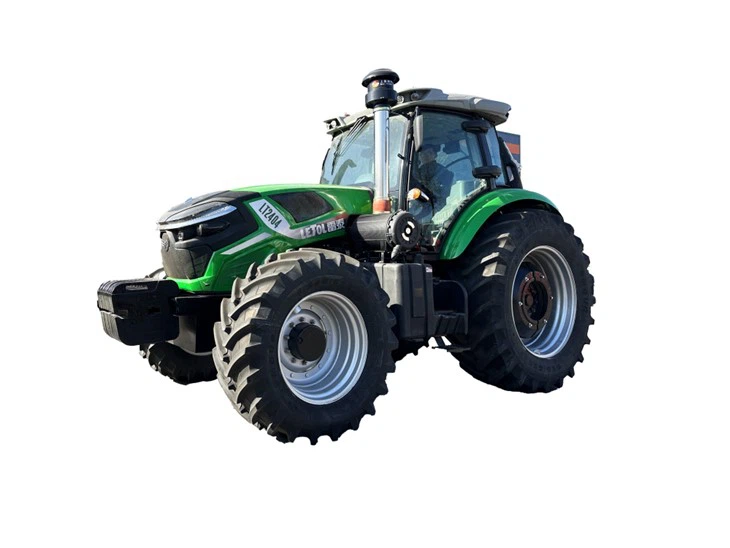
What is 4WD 240HP Tractor for Farm & Construction
Construction tractors are powerful heavy-duty machines designed to easily perform various tasks on construction sites. They play a crucial role in various construction related processes like site preparation, excavation and levelling of terrain.their immense power and traction enable them to operate efficiently in challenging terrains like uneven or muddy surfaces.
Benefits of 4WD 240HP Tractor for Farm & Construction
Increased Efficiency: Modern tractors streamline farm operations, lowering guide labour and completing responsibilities in much less time.
Precision Agriculture: Tractors geared up with GPS and superior sensors permit precise planting, fertilizing, and spraying, improving crop yields.
Versatility: From ploughing and seeding to harvesting and hauling, cutting-edge tractors can easily handle a wide variety of farm activities.
Comfort and Ergonomics: Amazing ergonomics enhance comfort during long working hours, lowering fatigue and improving productivity.
Environmental Benefits: Tractors with green engines and emission control structures minimise environmental effects at some point in farm activities.
Safety Features: Integrated safety technologies, including rollover safety structures (ROPS), ensure operator protection and reduce the chance of accidents.
Connectivity: Connectivity features allow tractors to be monitored remotely, permitting farmers to track overall performance, schedule upkeep, and troubleshoot problems.
Data-pushed Decision Making: Tractors equipped with onboard computer systems gather and examine information on soil situations, crop fitness, and gadget performance, facilitating knowledgeable decision-making.
Customisation Options: Modular designs and optionally available attachments permit farmers to customise tractors for unique responsibilities and terrain conditions.
Longevity and Reliability: Robust construction and advanced engineering ensure that cutting-edge tractors withstand rigorous use and offer dependable service for many years.

240HP 4WD Multipurpose Construction Tractor
● The engine has strong power, low fuel consumption and reliable quality
● The newly developed enhanced chassis, gearbox, gearbox housing, and rear axle housing are reinforced to improve reliability.
● Gear is 16 forward gear and 16 backward gear, the standard low-speed crawling gear, the minimum speed is 4.3 meters/min, can meet the straw baling, yam ditching and other different operations.
4WD 240HP Tractor, Built for Construction
● The engine has strong power, low fuel consumption and reliable quality
● The newly developed enhanced chassis, gearbox, gearbox housing, and rear axle housing are reinforced to improve reliability.
● Gear is 16 forward gear and 16 backward gear, the standard low-speed crawling gear, the minimum speed is 4.3 meters/min, can meet the straw baling, yam ditching and other different operations.

240HP Tractor, 4WD For Construction
● The engine has strong power, low fuel consumption and reliable quality
● The newly developed enhanced chassis, gearbox, gearbox housing, and rear axle housing are reinforced to improve reliability.
● Gear is 16 forward gear and 16 backward gear, the standard low-speed crawling gear, the minimum speed is 4.3 meters/min, can meet the straw baling, yam ditching and other different operations.

4WD 240HP Heavy Construction Tractor
● The engine has strong power, low fuel consumption and reliable quality
● The newly developed enhanced chassis, gearbox, gearbox housing, and rear axle housing are reinforced to improve reliability.
● Gear is 16 forward gear and 16 backward gear, the standard low-speed crawling gear, the minimum speed is 4.3 meters/min, can meet the straw baling, yam ditching and other different operations.

240HP 4WD Farm & Construction Tractor
● The engine has strong power, low fuel consumption and reliable quality
● The newly developed enhanced chassis, gearbox, gearbox housing, and rear axle housing are reinforced to improve reliability.
● Gear is 16 forward gear and 16 backward gear, the standard low-speed crawling gear, the minimum speed is 4.3 meters/min, can meet the straw baling, yam ditching and other different operations.

4WD 240HP Tractor for Construction
● The engine has strong power, low fuel consumption and reliable quality
● The newly developed enhanced chassis, gearbox, gearbox housing, and rear axle housing are reinforced to improve reliability.
● Gear is 16 forward gear and 16 backward gear, the standard low-speed crawling gear, the minimum speed is 4.3 meters/min, can meet the straw baling, yam ditching and other different operations.

240HP 4WD Tractor for Heavy Duty
● The engine has strong power, low fuel consumption and reliable quality
● The newly developed enhanced chassis, gearbox, gearbox housing, and rear axle housing are reinforced to improve reliability.
● Gear is 16 forward gear and 16 backward gear, the standard low-speed crawling gear, the minimum speed is 4.3 meters/min, can meet the straw baling, yam ditching and other different operations.
240HP 4WD Construction Tractor
● The engine has strong power, low fuel consumption and reliable quality
● The newly developed enhanced chassis, gearbox, gearbox housing, and rear axle housing are reinforced to improve reliability.
● Gear is 16 forward gear and 16 backward gear, the standard low-speed crawling gear, the minimum speed is 4.3 meters/min, can meet the straw baling, yam ditching and other different operations.

4WD 240HP Tractor for Farm & Construction
● The engine has strong power, low fuel consumption and reliable quality
● The newly developed enhanced chassis, gearbox, gearbox housing, and rear axle housing are reinforced to improve reliability.
● Gear is 16 forward gear and 16 backward gear, the standard low-speed crawling gear, the minimum speed is 4.3 meters/min, can meet the straw baling, yam ditching and other different operations.
Why Choose Us
Commitment to quality
We're committed to quality and concrete actions. That means we always deliver solutions in a professional and practical way.
World-wide expertise
We know international markets and trends. Our expertise, experience and network cover all corners of the world.
Competitive Price
We have professional sourcing team and cost accounting team, stive to reduce cost and profit and provide you a good price.
One-stop Solution
With rich experience and one-to-one service,we can help you choose products and answer technical questions.
Based on type of construction
- Riding type tractors – Tractors in which a driver can sit and drive e.g., General purpose four wheel tractors.
- Walking type tractors – Tractors with which the operator walks along e.g., garden tractors, power tillers.
Based on type of drive
- Track type tractors – In this type of tractors, instead of wheels; one track is fitted on either side. This track gets drive from the sprocket run by rear axle shaft. To steer the tractor, there is not steering gear fitted. The tractor is steered by applying brakes to one side of the track with the other track moving. These are used for bulldozing or land clearing work.
- Wheel type of tractors – These are most commonly used agricultural tractors. They can run fast and wheel tyres absorb a certain amount of field shocks also. These can be further divided as :
1) Two-wheel tractors – These tractors are used for small farms, hilly area and gardening purposes and are called power tillers.
2) Three-wheel tractors – These tractors were very popular 15 years back but now its place has been taken by four wheel tractors. These tractors had single or dual wheel fitted at the front end in the centre and were considered good for negotiable shorter turns.
3) Four-wheel tractors – These are most commonly used tractors in the country. These are also known as all purpose tractors. On the basis of available power, these have been classified as
(1) Small tractors – 15 to 25 hp.
(2) Medium tractors – 25 to 45 hp.
(3) Large tractors – More than 45 hp.
Based on purpose
- Utility tractors – It is a specific purpose field tractor and is designed for ploughing driving any other equipment through its P.T.O. drive. It is not being manufactured at present in the country.
- All purpose tractor – It is designed in such a way that it can meet practically all the demands for agricultural purposes such as ploughing, harrowing, leveling, pulling, seed drill, operating threshers, and pumps through its P.T.O. These are provided with three point linkages.
- Orchard type tractors - These are special types of tractors used in orchards. These are made very high in height so that driver while sitting on the seat, the operations on the trees could be performed. No part of the tractor is protruded outside so that tractor can go easily in between trees safely.
- Garden tractors - These tractors are in the range of 1 to 10 hp and are very small in construction. These are mostly used for kitchen or vegetable gardens.
- Rotary Tillers - These are walking type of tractors and are used in small fields or on hills where fields are very small and are at different levels where ordinary tractors cannot work efficiently. Tined blades are fitted to the tillers to prepare the seedbeds quite effectively by pulvlerizing the soil. These are also used in rice fields for puddling and other operations.
- Earth Moving tractors - These tractors are heavy in weight and strongly built available both is tract and tyre type. These are used for earth moving work on dams, quarries and other constructional works.
Comparison Of 4×4 Diesel Tractors And Other Tractors
| Feature/Specification | 4×4 Diesel Tractors | 2-Wheel Drive Diesel Tractors | 4×4 Gasoline Tractors | 2-Wheel Drive Gasoline Tractors |
| Engine Power (HP) | 40 – 130 | 30 – 100 | 30 – 100 | 20 – 80 |
| Fuel Efficiency (MPG) | 11 – 16 | 12 – 18 | 8 – 12 | 10 – 15 |
| Max Load Capacity (lbs) | 2,500 – 7,500 | 2,000 – 6,000 | 2,000 – 6,500 | 1,500 – 5,000 |
| Transmission Options | Manual, Hydrostatic, Power Shuttle, PowerShift | Manual, Hydrostatic, Power Shuttle | Manual, Hydrostatic | Manual, Hydrostatic |
| Traction and Stability | Excellent due to 4-wheel drive | Moderate, less effective on uneven terrain | Good, but lower torque compared to diesel | Fair, suitable for flat terrain |
| Best Use Cases | Heavy-duty tasks, rough terrain, large farms | Moderate tasks, flat or mildly uneven terrain | Light to moderate tasks, smaller farms | Light tasks, flat terrain, small farms |
| Durability and Longevity | High, designed for tough conditions | High, but less durable than 4×4 | Moderate, less durable than diesel | Moderate to low, less durable for heavy tasks |
| Maintenance Requirements | Regular, but less frequent due to robust build | Regular, slightly more frequent than 4×4 | More frequent due to gasoline engine | More frequent due to gasoline engine |
| Initial Cost | Higher ($25,000 – $70,000) | Moderate ($20,000 – $50,000) | Lower ($15,000 – $45,000) | Lowest ($10,000 – $35,000) |
| Operating Cost | Lower fuel costs, higher initial maintenance | Lower fuel costs, moderate maintenance | Higher fuel costs, higher maintenance | Higher fuel costs, highest maintenance |
| Environmental Impact | Lower emissions with modern diesel engines | Lower emissions, but not as efficient as 4×4 | Higher emissions, less fuel efficient | Highest emissions, less fuel efficient |
What Can You Use a Compact Tractor For
Construction support: Attach backhoes to your compact tractor to help with excavation - dig foundations or trenches for your construction projects.
Crop maintenance: Use mowers on your tractor to trim weeds and grass in your fields and orchards efficiently. You can also fit them with sprayers to make spraying fertilizers or pesticides easier.
Emergency response: Compact tractors are excellent for clearing debris like fallen trees after storms. Their strength allows them to create access routes for emergency vehicles on challenging terrains.
Field preparation: Use compact tractors to help with plowing. They efficiently break and turn over the soil, preparing it for your crops. You can also get harrow attachments to help smooth and level cultivated soil.
Material handling: Attach front-end loaders to turn your compact tractor into a material handler that lifts and transports heavy loads.
Landscaping: Compact tractors with rear blades are ideal for leveling and grading surfaces. They move efficiently and evenly, creating a smooth landscape. Additionally, you can attach backhoes to your compact tractor to help dig trenches, make planting holes or create landscape features.
Property maintenance: Use your compact tractor with brush cutters to clear any overgrown areas or attach augers to make digging holes for fence posts easier.
Road maintenance: Compact tractors with spreaders can evenly distribute gravel on roads and driveways. With filling and compacting attachments, you can also fill potholes.
Snow removal: In colder climates, you can equip your compact tractor with snow blowers to clear driveways and pathways. Adding front blades or plows can help you push snow aside.
Tilling and cultivation: Their maneuverability makes compact tractors great for navigating garden spaces or tilling soil for flowers, herbs and vegetables. You can also get attachments for cultivating between rows, helping with soil aeration and weed control.
Utility work: Use your compact tractor with trenchers to create trenches for utility lines or attach augers to dig holes for signposts and fences.
What are the different types of tractor tyres
R-1 Tires: R-1 tires are standard agricultural tires designed for general farming use. They are ideal for plowing and tillage work.
R-1W Tires: R-1W tires are designed for wet conditions and have larger lugs to improve traction in muddy or slippery conditions.
R-2 Tires: R-2 tires are designed for intermediate to heavy duty applications and are commonly used for row crop farming.
R-3 Tires: R-3 tires are designed for heavy-duty applications and provide good traction in muddy conditions. They are commonly used for orchard and vineyard work.
Flotation Tires: Flotation tires are designed to provide maximum flotation on soft or uneven terrain. They are ideal for use in fields with a high soil moisture content.
Industrial Tires: Industrial tires are designed for use on construction equipment and provide good traction on hard surfaces.
Turf Tires: Turf tires are designed for use on lawn and garden tractors and are designed to cause minimal damage to delicate lawns and landscaping.
Our Factory
Currently, the company boasts a casting production line, a complete and efficient CNC machining line, whole machine assembly line, electrophoretic painting line, and a full set of component and whole machine testing equipment. The current annual production capacity reaches 8,000 units, with a new factory area capable of producing 30,000 units annually under construction and expected to be operational by 2024.


Certifications


